Friday, November 02, 2007

Penultimate Romanian Film

The Romanian film festival here is drawing to a close, and tonight's California Dreamin' (endless) will be the last screening. I've now managed to attend three, Stuff and Dough, The Paper Will Be Blue, and then last night's Occident.
Occident was, perhaps, my favorite of the three. It presents three intertwined narratives (or was it four? I'm losing track) about urban Romanians in the very recent past... set right around 2000. The characters are likeable, if often foolish, and all are trying to come to terms with post-revolution Romania. Some are determined to leave, some think it's better to stay, and one has left and returned.
I admit to a weakness for tales told in this multiple-story manner; I have always liked, for example, Lawrence Durrell's Alexandria Quartet, which combines changes of narrator and progression of time to provide an added, surprising dimension to novels which are already rich and subtle in themselves. Robertson Davies' several trilogies also work somewhat in this manner, although they are not designed as quite such puzzles. Occident weaves its interlocking stories and perspectives quite well for a feature-length film, and conveys the stories with a charming sense of humor while nonetheless dealing with some sad events and intense emotions, but here and there I did wonder whether bits of information got lost on the cutting-room floor.
Altogether, it is decidedly to be recommended.

Labels: , ,

Friday, October 26, 2007

More Romanian Film

I'm pleased to say that I liked the latest offering in the Romanian film series, The Paper Will Be Blue. Just as minimalist as Stuff and Dough, this film deals with the experiences of a squad of militia men on one night during the 1989 revolution. Everything is confused, no one knows quite which side to take or what to do. It's a poignant little slice of life with a sad outcome.
I'm less pleased about the implementation of Blogger's new email notification feature. I was horrified to find my email address showing on the comment page this morning, seemingly inviting the entire world to email me personally with its comments on the blog. It took some hunting around before I discovered that that's not what's going on at all. It's actually a tool for people commenting on blogs to keep track of responses to their comments, and each person only sees his or her own email address. In other words, I can choose to see responses to my comments on Kristen's blog, or keep track of how many people have posted congratulations on the new BibliOdyssey book. Or if you want to receive emails with comments subsequent to your own on this blog. So... the idea is fine, but the implementation is less than ideal. I'll bet a lot of bloggers were unhappy to see their email address showing up on the comment page this morning and made the same assumption I did. (And if my readers express a deep longing for a means of emailing me directly, I'll consider getting an account strictly for this kind of thing, OK?)

Labels: , ,

Tuesday, October 23, 2007

Romanian Cinema on the Edge

Since I was just complaining about the impossibility of finding out about the myriad cultural events here, I will point out that the present Romanian film series is unusually well publicized.
It is true that the main reason we have a poster for the series on our TA Office door is that Cristina, one of my art history colleagues, is from Romania and was involved in putting it all together. There are, however, posters pretty well distributed around campus and in local cafes; Irina Livezeanu, who curated the series, assured me that there was a strong postering effort and that press releases and PSAs were sent out. I even found the films listed on our Student Events Calendar (admittedly rather incorrectly, giving the impression that every film shows every night), which bills itself as "the ultimate guide to life outside the classroom" but is in fact nothing of the kind. (In its defense, perhaps no one submits events to it? It only lists four events for today, which is rather thin for a university of "about 34,000 students.")
Anyhow, I wasn't paying attention, so I missed the opening film of the series, the classic The Reenactment, which I hear was excellent. On Friday afternoon I did manage to get to a lecture by visiting film critic Alex Leo Serban, which provided something of an introduction to recent Romanian cinema to ignorant parties like me who were unaware that Romanian film is currently, and for the first time in its history, the height of fashion. Apparently these films are winning international awards right and left, but no one in Romania goes to the movies anymore. There are, it seems, only thirty movie theaters left in the entire country. (The younger generation, one student informed us, downloads all its films off the internet. I was surprised that the Romanian public has so much bandwidth at their disposal, since when my friend Betty sent a link to her son's latest film project the other day, my DSL connection wasn't quite fast enough to watch it smoothly.)
I was a bit surprised by Romanian lack of interest in Romanian cinema, as while the Czechs like to complain that their film industry is poorly funded and that not enough films can be made, the urban Czech public, at least, seems eager to see films in the theater. On the other hand, the Czech situation has never seemed to have very much in common with the Romanian, and as regards film, the Czechs have been making very well-regarded films practically since the beginning of time. I did not get the impression that the Romanians had such a long love affair with cinema.
The film shown Friday night, Stuff and Dough (Marfa şi banii) was a worthy effort, but I confess that after a certain point it failed to hold my interest. Yes, it deals realistically with current social problems, but let's just say that I've seen my share of films about long road trips; ditto films about inarticulate, directionless, uneducated, and unintelligent youth; ditto films about post-revolutionary Eastern European crime and social malaise. After a certain point I was very anxious for the protagonists to reach Bucharest and stop having boring conversations; and I'm afraid that nothing about the film's end was at all surprising to me, it was pretty much exactly what I expected. On the other hand, it is entirely possible that the dialog was more engaging in Romanian. When I watch Czech films, I always catch at least a few nuances in the original that just don't get into the subtitles. But I can't say I have cared for all of the recent well-regarded Czech films either. I've been known to enjoy road-trip films (I liked Výlet, for instance, and for that matter Ross McElwee's Sherman's March although that's not quite your standard road-trip film), and I'm not immune to the lure of gritty, depressing films about criminals, disaffected youth, or post-revolutionary malaise. Still, something has to grab me. Perhaps I feel sympathetic toward the characters. Perhaps something appeals to my twisted sense of humor. Perhaps the cinematography and scenery are captivating. Perhaps the soundtrack hooks me (I'm convinced that Fargo works partly because of the music).
Oh well. More films are coming up, and I will get to at least some of them. With luck, I too will get all excited about contemporary Romanian film.

Labels: , ,

Tuesday, October 16, 2007

I Complain

All colleges and universities have their quirks, I am sure, regarding what is easily found on or near their campuses. It is possible that, as an undergraduate, I was simply so dazzled at having so many resources within walking or bus distance that I was completely unaware of what was missing, but it is true that I cannot come up with a list of things I felt were lacking at UCSC.
Perhaps I am more demanding these days; the lack of lunch options on and around the American University campus, for instance, may be no more severe than what I experienced at UCSC when I ate most of my meals in the cafeteria. I was, however, very much annoyed at AU's paltry range of choices, which was much exacerbated by the near-nonexistence of affordable lunch in the surrounding neighborhood.
The University of Pittsburgh is not lacking in varied dining possibilities, I am glad to say, although I have been known to complain that when the parking lot near our building was turned into a park, we lost out on all the Asian food trucks, which were replaced by some very unimpressive kiosks. (Since when do I want to pay $1.85 for a can of ginger ale? Why is the food at the Chinese-Japanese kiosk so limited and bland?)
I have concluded, however, that University of Pittsburgh is seriously lacking in any functioning method of informing the world of lectures and cultural events. I have not found its various newspapers very helpful, whereas I relied on UCSC's City on a Hill to provide me with a convenient list of everything going on during the week. At UCSC, if I missed a play, a film, or a concert, it was not because I was ignorant. At Pitt, on the contrary, it is some sort of a miracle if I hear about any of these things. Here, one must either hang out in the correct building (or floor of same), or be on the right mailing lists. In other words, since I am not spending time in the German Department, I have no idea what German films are being screened. Since I do not normally go over to the Music Building, I only accidentally found out that we have a gamelan and that my former gamelan teacher was performing with it. Since I am seldom over at the Theater Department, I am usually clueless what plays are being put on and where our theater spaces are.
I thought matters would improve when, rather tardily, the Russian and Eastern European Center got around to putting me on its email list. (This happened shortly before I went to Prague; I was completely unaware of three years' worth of events prior to that.) Apparently the improvement is slight. I do get numerous emails about lectures on political and economic topics, regarding which my interest is rather slight although I do like to know about these talks. Some weeks back, however, I heard mention of a Russian film series, which was, I believe, occurring on Tuesday nights.
In my vague and dilatory sort of way, I finally got around to checking my emails to find out the time and room number for this series.
Was there, in anything Slavic-related, the slightest mention of such a series? Certainly not! I am glad to say that I know all about the Romanian film series (both via email and because a Romanian colleague has put a poster on our TA office door), but why is the Russian series such a secret? I'm all for improving my knowledge of Russian film, which currently doesn't go much beyond Eisenstein, Vertov, and a bit of Tarkovsky. For that matter, some years I miss out on the Slovak film series, and I usually hear about any Czech series after they have ended.
I feel aggrieved about this.
On the other hand, yesterday I was able to get my muffler fixed with great speed, although at appalling expense.
I suppose one cannot expect everything to go quite according to one's inmost wishes, although one would think that proper promotion of cultural events would be an all-around winner.

Labels: , , , ,

Monday, July 16, 2007

Teige and Studio

Studio, which was published by the tireless Otakar Štorch-Marien, appeared in 1929, filled with glossy stills from films of many countries and articles by a fair assortment of recognizable names. Naturally, Karel Teige wrote at length on film aesthetics (Teige always, it seems, wrote at length, at great length, and at even greater length).
It would appear that Teige got quite a few contributor's copies of the magazine, possibly in lieu of cash since I suppose the practice in paying in copies rather than cash cannot be one that began during my own writing life. In any case, he had spare copies lying about, which he eventually put to good use when he took up collage.


I'm not sure whether there was a second year of Studio. It must have been expensive to produce and once the Depression hit (it hit Czechoslovakia as well as the US), Štorch-Marien began to have trouble keeping his publishing empire afloat. By the mid-1930s he was in bad shape. And that was right around the time Teige became a surrealist and took up collage.

Labels: , ,

Sunday, July 15, 2007

Silent Armadillos

In honor of the San Francisco Silent Film Festival (I attended Camille and Beggars of Life last night with Cesar and Jeff), I offer this fine photo from the 1920s Czech film journal Studio. Not only does it include Richard Arlen, who along with Louise Brooks and Wallace Beery made Beggars of Life a highly worthwhile experience, but it is the only instance I have ever seen of anyone petting an armadillo.
Armadillos are perhaps best known as animals that seem to get run over frequently on Texas highways (is this somehow, by any chance, related to all the people who are legally executed by the State of Texas?), but I rather like them and they also have their place in surrealism. I gather that one of Dora Maar's more bizarre photographs is merely a portrait of a very young armadillo.
Well, anyhow, the film festival seemed to be packing in the silent-film afficionados and I am guessing that the Castro, which is a pretty large theater, sold out both shows. We were very pleased with both features and also the accompanying shorts. Although... I regret to say that none of us were among the lucky few to find a voucher for a free "Camille" pillow under our seats.

Labels:

Saturday, June 23, 2007

This and That

Not too surprisingly, I arrived in California without incident. And, very pleasantly, my cell phone battery and credit lasted just long enough to let John know I had reached the baggage claim area, and for him to let me know he was on his way there. Once we got into San Francisco, he fed me a very fine lunch involving stuffed peppers and a pasta-and-lettuce salad. I guess I too will have to get a copy of the Moosewood cookbook, since he keeps finding good recipes therein.
Ms. Spots and Orion were, I think, a little affronted that once I arrived I spent so much time in conversation with John and my parents, but once John left, they took a different view of things and Ms. Spots gave my hand a hearty welcome licking. As the senior rabbit, she grew a bit dubious whenever I gave Orion too much attention, but he has been placating her with lots of adoring grooming.
On the Czech front, Hubert, who is now staying with his friend Josef, sends this photo of the perusal of elderly copies of Cosmopolitan (c. 2001) purloined from my apartment. I bow to Kristen and Dr. Zaius' superior information regarding the frequency of use for the term "bootylicious" but I still think this is not a term that is going to be known to many people who have not read at least one issue of Cosmo. I have probably read every copy that was to be found in the apartment, and I still don't really recall it, as my attention went more to the stories about women who woke up to discover their new beaux were toothless or underage (or maybe even both, heaven forfend). But I am glad to see that Hubert continues to extend his knowledge of the stranger side of pop culture, as well as composing lots of new music.

Also somewhat on the Czech front, last night John and I attended a Czech film at the Pacific Film Archive. This particular one, a 1947 tale of a strike in 1880s Kladno (based on something by Marie Majerova), was not one of Czechoslovakia's most impressive cinematic offerings. We agreed that the cinematography was the best part, although John still had many criticisms of how it was done, such as the lack of a consistent viewpoint, the combination of Expressionist and other types of lighting, and so on. I was very disappointed that the score, by E.F. Burian, seemed to detract rather than add to the film. Burian was one of the major interwar avant-garde composers and directors, and I expected better from him than bombastic mid-century cliches that didn't even go well with the film. John thought that there were some impressive bits of orchestration but that otherwise the music detracted. In general, he thought that the other Czechoslovak strike film he had seen was much better. Since it starred Voskovec and Werich, I'm sure it was a far superior effort.
My other main adventure since arriving in California has been to get an American cell phone and service. I had resisted this for a long time, but it was so convenient to have a cell phone in Prague, and John has now gotten a cell phone to which he claims to have become devoted, and thus I have succumbed. After a morning of diligent research, I settled on a blue Motorola RIZR Z3 and a prepaid T-Mobile SIM card. While I like the general design of my old Siemens, which I'm keeping for future European use, I must confess that the Motorola is much more exciting and appears to be easier to use as well. It's a slider phone, which will eliminate all those annoying times when the phone somehow dials the internet on its own and uses up half my credit. The interface seems easier to learn and it even takes pictures. I did not think I would ever want a camera phone, given that the quality of photo is not that great, but after watching Shawn whip out his phone and capture a particularly ludicrous example of tourist costuming, and also having seen Jesse unobtrusively photograph lots of signs on trams and trains, I decided that a camera phone does have a place in my life. Quality is important, but so is getting the shot.
I believe it is now time to go and pet the Spotted Pair.

Labels: , ,

Monday, May 07, 2007

Online Documentaries!

Being exhausted from a weekend of nonstop visits, I direct you to Take a Swig of Alf, which reveals where to find lots of full-length documentaries online. Pretty impressive. I wouldn't try these on dial-up, though.

Labels: ,

Sunday, February 18, 2007

Back from Austria

I returned safely from the Austrian ski extravaganza at about 1am last night (I was able to catch the last #14 tram across the river by running after it, and then got the trusty #52 night tram the rest of the way). However, I don't think I am yet able to stare at the screen long enough to say much more about it.
Instead, I offer some entertaining tidbits:
Dirk has sent word of a Czech modernist film festival in Chicago. Find out more here!
Jesse, knowing that I would like to be well informed about these things, has located an article about sex shops in Budapest.
Another item that shouldn't be missed is this photo of the standard Slovenian physique as depicted in art deco bas relief. I must say I am relieved that the person of Slovenian descent in my life does not look at all like this and apparently resembles some other part of his ancestry. The excessive musculature could be tolerated if need be, but it would be pretty alarming to dine out in the company of a face like that, let alone what it would be like to have it glaring at you first thing in the morning.

Labels: , ,

Tuesday, January 03, 2006

On Holiday Time (or not)

While the rest of the world (mostly) has gone back to work, my brain is still largely on holiday time, which means my mind is on food, conversation, walks, and other simple pleasures. Thus, the leek-and-potato soup was made and has partly been eaten (there was a lot of it), I won a game of Scrabble, and Jesse and I watched Divoké včely and Pupendo. (Which I should describe, but am too holiday-like to bother.) This afternoon we decided to finish off the pie before Jesse caught the train (or bus, as the case may be) back to Brno.
Unfortunately I seem to have allowed a chip of plum pit into the pie; there was a great CRUNCH and next thing I knew, I felt quite certain that I had cracked yet another tooth.
This put a damper on my mood, as it seemed much more significant than the piece I had lost before Christmas and was planning to have fixed in the New Year.
I had to decide where to take my crumbling mouth. My mental preference was to go to an ordinary Czech dentist of some sort, but on an emotional level this just didn’t work. I can’t stand novocaine, which seems to exacerbate any existing pain rather than numbing it, and I’ve been going to the same dentist since I graduated from college. I felt an English-language dentist was required.
And so, I’ve been to the dentist and learned—just as I suspected—that I finally have to get a crown. She was a little skeptical of going without anesthetic, but when I told her that I had had nearly all my fillings done without it and had a wisdom tooth pulled in the same manner, she said we could give it a try.
We will see if I can manage not to break any more teeth before I go in for my crown on Friday.

Filed under:

Labels: , , , , ,

Monday, January 02, 2006

Silvestr at Karla's House of Pleasure

New Year’s Eve is celebrated in the Czech Republic much as in the United States, but by the name of Silvestr. A great many people do nothing in particular beyond staying home and watching TV (endless Silvestr specials featuring every Czech entertainer imaginable, with flashbacks to Silvestr specials from the distant past). Other people, however, go out to restaurants and parties and suchlike. I gather that Staroměstské náměstí and Václavské náměstí become a seething mass of international drunkenness.
It occurred to Jesse and me, however, that New Year’s Eve would be an ideal time to prepare another feast in my kitchen. After a visit to the grocery stores for ideas, I formulated a menu of leek and potato soup, roasted vegetables, risotto, cranberry sauce, and a plum, apple, and cranberry pie. Several other Fulbright grantees were bound to be available to join us (as indeed they were).

The soup was put off on the grounds that it looked like there would be a massive amount of food without it, but everything else went together without any problem, despite the fact that Jesse’s train was delayed significantly (permitting him to watch a dog fight at the Brno train station and consider acquiring Jehovah’s Witness information on Armageddon to pass the time). When he arrived, I put him in charge of the pie crust as presumably this one would not self-destruct (it did not).
Dawn was the first guest to arrive, as she had another engagement to attend, so round one of the dinner was eaten.
Shortly after her departure, Hubert arrived. He had been slaving over a string quartet and required a break from the rigors of composition, so I began to tell him about the interesting museum Megan and I had visited the previous day.
Megan then called from the tram stop for further directions, so, as my hands were covered with plum, Hubert picked up the phone. “Karla’s House of Pleasure,” said he. (Megan had to give the rest of the details of the museum herself.)
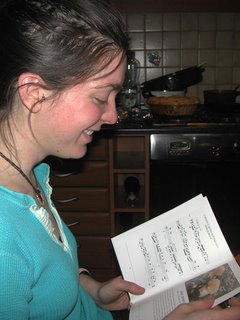
Phase two of dinner was successful and suitably merry. Jesse had found a remarkable volume in a Brno bookstore, the Hudební atlas hub (musical atlas of mushrooms), whose author has composed music for each of numerous types of mushroom. We examined this singular work and also played selections from the accompanying CD. Unfortunately the CD player on my laptop was being a little finicky, but the pieces sounded listenable.
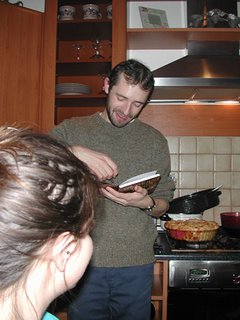
Hubert had brought along some DVDs, so we then watched Kalamita, an older Věra Chytilová film starring the ever-popular Bolek Polívka. It was pretty good, although I gather it was very different from some of the director’s other films. The ending was a bit dull in comparison to the rest.
At that point, it seemed about time to head over to Vyšehrad, which Věra had told me was a popular place for less crazy Silvestr celebrations. The Vyšehrad fortifications are about a mile north of my apartment—a nice walk, generally. There was a bit of precipitation of the rain (versus snow) variety, but not enough to warrant umbrellas. Some of the streets in Podolí had Christmas decorations up, and as we approached Vyšehrad we came across others headed in the same direction.
Up on the ramparts there were lots of people looking out over the city, many of them shooting off fireworks. I am really not accustomed to being in close range of fireworks, but on the whole I felt much safer than I would have expected, as the fireworks (many of them the kind I would only expect to see at a municipal display) were mostly set off into the distance. People on other high ground around Prague were doing the same, so the show was quite impressive until fog and smoke took over the atmosphere. Even then, it was still worth watching. People were animated but, as Věra had indicated, not wildly out of control.
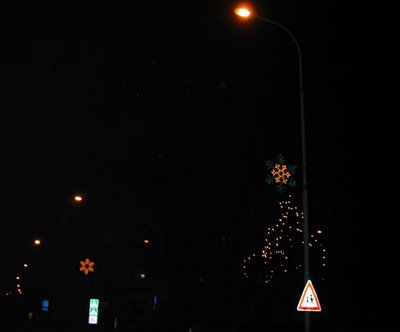
Decorations in Podoli
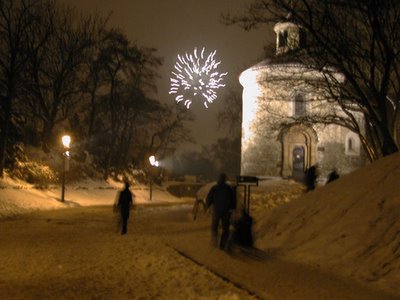
Fireworks on the way up to Vyšehrad
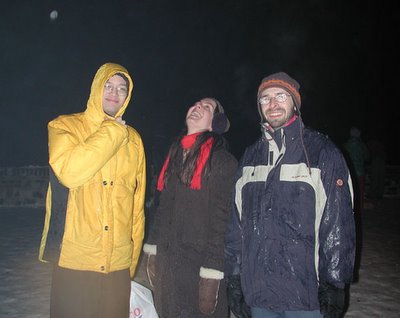
Up at Vyšehrad
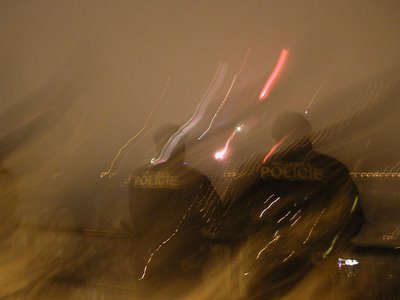
The police watch fireworks

When we began to head back, we found that the cobblestones had gotten really icy. While we made it safely back to my apartment, the journey was a bit hazardous and there were a few falls and near-misses.
Under these circumstances, it seemed pointless for Hubert to go home, so I had three overnight guests. This certainly called for prompt deployment of Hovoříme s hostem, but I didn’t think of that, merely of which bedding I could bring forth. (I am glad that Sandra owns what would usually appear to be a surplus of pillows and pillow cases, so no one had to go without these.) The living-room supply of Cosmopolitan provided bedtime reading matter for those who had not brought their own or who were not in the mood for volume 3 of Karel Teige’s writings on art.
In the morning, I fed my guests coffee, tea, and a ten-egg omelet or frittata (there was some discussion as to which it was). Hubert proved to be a most meticulous onion-slicer.
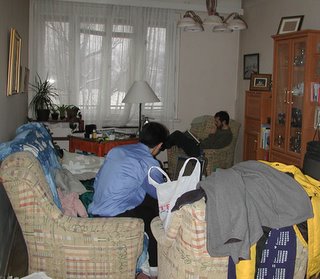
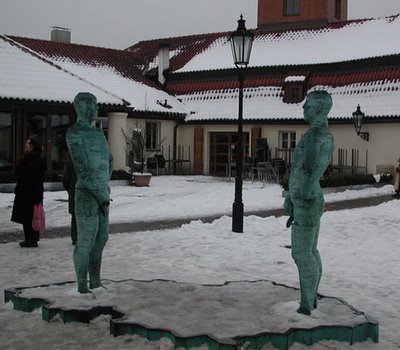
Megan told us that she had run across a blog with a photo of a most peculiar fountain, which we agreed we ought to make a resolution to find and photograph that very day. Megan was able to find the blog with the photo, but no precise address was given. There was, however, a link to the artist’s website—it proved, not surprisingly (to me), to be a recent work by the Prague sculptor David Černý. (Černý is one of the best-known contemporary sculptors here, and does pretty interesting and often satirical stuff. I got to hear him talk about his work when my Czech course visited him in 2003. On the whole, I like what he does. He is especially known for having painted a statue of a Soviet tank pink.) We thought that as it sounded like the sculpture was on the Kampa, we could probably find it.
Off we went. The Kampa is not large, although it is somewhat labyrinthine. We explored the section south of the Charles Bridge exhaustively without finding any sign of our quarry. Perhaps it was simply in greater Malá Strana and not on the Kampa. We left the Kampa and found Shakespeare and Co. bookstore, which met with our approval. We then saw another sign for Kampa and followed it. Eventually, in the courtyard of the new Kafka Museum (I am not sure how many Kafka Museums there now are in Prague), we found our statue. Unfortunately, it being winter, the fountain and mechanical parts were not in use. We did, however, take quite a few pictures, after which it seemed like time for more food.
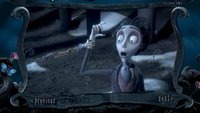
After this meal, Hubert decided it was time to return to his string quartet, and the rest of us met up with Dawn to watch Corpse Bride in Smíchov. The tickets were exorbitantly priced, but the movie was rather fun.
Megan really did have to get back to Kutná Hora, so after bidding Dawn adieu, Jesse and I accompanied her to the Hlavní nádraží. We did this not because Megan cannot get to the train station by herself, but because the three of us had formulated a plan for anthropological observation of the train station’s clientele. Not the ordinary travelers, of course, but the seedy characters who spend lots of time there. On this expedition, however, we did not see anything too remarkable. One homeless person had brought his own lawn chair to sit on, which I expect was more comfortable than the slab his companions were seated on. Unfortunately capitalism has brought its evils as well as its benefits to the Czech Republic, and thus there are now homeless people who need a warm place to stay on winter nights.
We are not very thorough anthropologists, however, so shortly after Megan’s departure Jesse and I returned to my apartment and watched Balada pro banditu. This classic musical was filmed in the 1970s and is still performed as a stage play (See Jesse's review of a recent instance) but neither of us had seen the film. While the story is set in Ruthenia during the First Republic, the film has a rather sweet and very 1970s counterculture ambience. Even with the English subtitles, I thought most of the plot and exposition had evaporated; without Jesse’s greater knowledge of the story, I would have been baffled. At the same time, we found it very enjoyable to watch and listen to. It has a nonrealistic, poetic atmosphere (imagine Robin Hood and his Merry Men out in the forest, but at a 1970s Renaissance Faire), and Bolek Polívka gives a memorable performance as Mageri the Jew. It made a pleasant end for New Year’s Day and the music at the end of the DVD loops so skillfully and is so lulling that there is no need to turn it off immediately, especially if (as is normally the case in my living room here) the film is being watched by candlelight. You can just sit there and watch the candle flames and listen. Thoughts of archival research have retreated far into the back of the mind, as should generally be the case over the holidays.
(And now: you are growing v e r y s l e e p y…)

The water wheel at the Kampa

Note: You can see a photo Dawn took of us here.
And Jesse has now written about Silvestr, also with photos.
And Megan also writes about Silvestr, using some familiar photos.

Labels: , , , , , , , , ,

Sunday, December 18, 2005

Highly Dissimilar Films

Following the excitements of the Fulbright meeting (well, all right, it wasn’t that exciting of a meeting, but it had its moments, and those of us who haven’t been teaching got to learn how bad attendance is in many schools)… some of us decided it was time to go to the movies. Ideally, I suppose, we would have gone to Czech films, but Jesse and I had been wanting to see the new Harry Potter movie, so we headed over to the Slovanský Dům complex where one can often find non-dubbed versions of major releases.

I had seen the third Harry Potter film at Slovanský Dům last summer with Štěpanka’s son Michael, but I don’t think I had quite realized how large a place it actually is. I still may not know. It has several floors of theaters, with about ten screening rooms in the basement alone. I don’t think I saw any movies at all in Communist Czechoslovakia, so I have no way of comparing present to past except that I am certain that there weren’t multiplexes here at all then.
On the whole, we thought the film was pretty good. The three lead actors continue to do a remarkable job; I don’t know how they manage to sustain and develop their characters for year after year unless they have simply been brainwashed into becoming Harry, Ron, and Hermione. One does worry that being child stars will warp their characters, but I confess that I selfishly hope they can keep up the good work indefinitely.
Since the novels become increasingly complex and of course rely increasingly on one having read the previous installments, each movie must be more of a challenge to script. More and more things have to be left out or ruthlessly abbreviated. This was rather noticeable. The opening Quidditch match is pretty important and well developed in the novel, but isn’t really dealt with properly in the film and should probably have been scrapped. Likewise, Barty Crouch isn’t given enough space in the film and his death seems like a footnote—not that I’m sure how he could have been better handled. (I am glad not to be writing movie adaptations of novels, as no one is ever satisfied by even the best attempts.)
Still, one cannot carp too much. The movie overall is beautifully designed, the acting is as always nearly uniformly excellent, the characters develop as they age, and there is plenty of suspense. (Although why the intermission was put at the end of the bath scene is a mystery. It gives the impression that the ghost Moaning Myrtle seduces the unwilling Harry, which is a disagreeable and pointless thing to worry about over an entire intermission.)
After leaving the theater, it occurred to us that Hubert had SMS’d us in the morning about another film, which he had mentioned the night before. We had some doubts, but were soon joining Hubert at Světozor to see Cafeh Zahedi’s autobiographical documentary I am a Sex Addict.
Hubert had seen this film before when he and the filmmaker were residents at the McDowell colony. Jesse and I were skeptical about following Harry Potter with anything about prostitution, but while the overall topic and intent were serious, the presentation was by and large pretty funny. It is not an easy film to describe, but by using a very self-conscious narrative style, with re-enactments of various events in his life, Zahedi manages to tell the story of how he became obsessed with prostitutes and eventually realized that this was a real problem. The three of us were intrigued from beginning to end (although of course we also like anything that makes us laugh frequently). Still, I’m not sure I would recommend that anyone follow our lead in watching both Harry Potter and I am a Sex Addict in the same day.

Filed under:

Labels: , ,

Monday, November 21, 2005

Premiere of the New Švankmajer Film

I arrived in Brno Friday evening on a non-express bus that was, nevertheless, on time despite its feeling for about half the trip as though we were jolting along on a flat tire. (Some of you will recall that I got a flat tire in Wisconsin this summer and initially attributed the sensation to increasingly poor highway, which did indeed seem to begin the minute I crossed the border from Illinois. I am now very alert to abnormal bumpiness on the highway, although in California these days all roads feel in need of repaving.)
Bus issues aside, I arrived in time to have a quick dinner with Jesse and get to the local multiplex for the new Švankmajer film, Šílení (Lunatics). According to the theater, it was the premiere, but you would not have guessed this otherwise, as the theater was relatively empty and there were no festivities. Presumably the official premiere was occurring in Prague. (It occurred to me to wonder what that could have been like, considering that Eva Švankmajerová had just died and it is likely that Jan Švankmajer was not feeling especially celebratory.) And who knows, perhaps the inhabitants of Brno just don’t care for Švankmajer films. I don’t suppose that most people in any city do.
We, however, like to see weird films that most people don’t like. We don’t always like them either, but they do have to be seen. Well, some of them, anyway.
The Švankmajers are/were part of the postwar Czechoslovak surrealist group, indeed probably the members best-known abroad. When I tell people that I am working on Czech surrealism, their assumption (if they have ever heard of it in the first place) is that I must be studying the Švankmajers. Since I don’t actually know all that much about the postwar Czechoslovak surrealists (as opposed to the original interwar gang), the least I can do is try to familiarize myself with the Švankmajers’ large and significant oeuvre so that (at worst) I don’t look like a complete dummy and (at best) I can have a better understanding of the overall surrealist movement here. This means that I went to the major Švankmajer retrospective last summer (and probably spent much too long examining the grotesque assemblages made out of various bones and taxidermy animal parts) and that I welcome the chance to watch the couple’s (or just Jan Švankmajer’s) films. While the films are often a bit repulsive, they are also brilliant in their own inimitable way. I will not soon forget the experience of watching Otesanek during my August Czech course last summer. One of my classmates and I were repeatedly laughing uncontrollably at various lines or scenes (Otesanek is a relatively mainstream sort of Švankmajer film and can be shown to a general audience of people over ten), and one or two other people in the audience indicated that they had also liked it, but my impression was that most of the other students thought it was sick (the maternal instinct does not come off looking too good) and not to be mentioned in the same breath as that lovely, heartwarming film Želary that we had seen a week or two earlier. (Well, Želary is a pleasant enough romance, but the world is full of those, whereas Otesanek is in a class of its own.)
Thus, Jesse and I were not too sure what to expect since we had only seen brief previews for Šílení, but we both like Otesanek and find the short films pretty interesting, so it did seem we really ought to see this.
Šílení opens with a warning that there are only two ways of looking at the world, unless you take a third path that partakes of the extremes of both of the others and approach life as a lunatic.
In a nutshell, Šílení is the story of an unfortunate youth named Jean who has recurrent nightmares of porcine grinning asylum attendants coming for him with a strait-jacket. His mother, it transpires, has been a patient at Charentin. Jean lives to some extent in the twentieth century, but after one of his attacks makes the acquaintance of the Marquis de Sade, who takes a fancy to him. The Marquis insists on taking Jean out to his chateau (evidently not the Chateau de Silling but perhaps a reconstruction of Chateau La Coste), where Jean has some rather unsettling experiences. After the Marquis rises from the dead (or a cataleptic state) and tears the lid off his coffin, he takes Jean for a visit to the local insane asylum, the setting for the remainder of the film. Jean, who is goodhearted if not remarkably bright, ends up making what turn out to be (but might so easily not have been) some errors of judgment. (It should be noted that women are not necessarily trustworthy in this film.)
This little summary is, of course, leaving out the role of the animated pieces of raw meat that punctuate the various scenes to the sound of a fairground calliope. You can’t really have a Švankmajer film that lacks horrible foodstuffs or perverted relationships with food and/or body parts. But perhaps I will refrain from describing the antics of the raw meat, as most of my readers will already have been sufficiently disgusted and the rest will go and see the film for themselves.
This film is decidedly not for everyone. We noticed that a significant portion of the audience found early on that it was really too much for them, although anyone who has seen more than two or three other Švankmajer films ought to have no illusions that it might be cute or innocuous. Even people who liked Otesanek might find that Šílení is just too savage.
On the other hand, while it is not a film that most people would find enjoyable in the usual sense (it is hard to imagine not being uncomfortable at least now and then while watching it), it’s really very good in its horrible, uncompromising way. As might be expected from surrealist filmmakers, it is not about sadism (certainly not extolling it), but about human fears and anxieties in an unpredictable and often cruel world. The Marquis is an unpleasant and frightening character, but perhaps not the worst of the lot. The film does follow standard surrealist thought in theorizing him as an important and neglected Enlightenment philosopher. Not, perhaps, a very sane one, and certainly not one you really want to visit, but one who shouldn’t be ignored.
It’s a little weird listening to big chunks of Czech translations of the Marquis de Sade’s writing (and apparently also pieces from Huysmann, presumably used in the satanic scene) spewing relentlessly from the actor’s mouth, but then the character’s two main modes are harsh philosophical ranting and maniacal laughter. And, in a strange way, it works. The character is repulsive, but fascinating.
It’s also a bit unsettling to see the same actors in the main roles that one sees in lots of other Czech films—minus Boleslav Polivka, who probably has too lovable a persona to insert here—but that’s typical of the Czech film industry. I am terrible at keeping track of actors and their names, but even I can recognize that I’ve seen these people before, some in quite a selection of roles. In a way, it adds to the nightmarish quality to know that you’ve seen some of these people playing Nazis or troubled youth elsewhere.
Anyhow, it’s quite an interesting film.
Some links about the film (text in Czech):
Czech TV
Tiscali

Labels: ,

Thursday, November 17, 2005

Kinsey in Czech


Brno and Prague are currently holding their sixth annual Mezipatra gay and lesbian film festival. It is a little hard to tell from the program how many (if any) of the films are actually Czech, but it is clearly an international selection, with offerings from the United States, Britain, France, Spain, and Finland, among others. Everything is shown in the original language, with either Czech subtitles or simultaneous translation.
It does occur to me that the Czechs may be reluctant to include items from their apparently large gay porn industry; perhaps this is because Czech gay-porn actors are busy telling the world that they're actually heterosexual and only in it for the money, but more likely the festival is trying to emphasize films with... ahem... some artistic and narrative content. Then again, maybe it has something to do with the assurances the porn actors get that the films will only be shown outside the Czech Republic, where Grandma and the guys at the pub might not see them (although as I gather they are mostly for internet use, I don't see why Grandma and friends couldn't download them).
Not knowing anything about most of the films beyond whether their content was a) lesbian, b) gay, c) trans, or d) other (whatever that might mean), thus far I have only gotten around to seeing Kinsey, which I had sort of meant to see in the US and (as usual) was too sluggish to get to.

Oddly, the festival categorizes Kinsey as a gay film, although surely it must be one that really falls under the rubric of “other.” However, it is certainly gay-friendly, and I suppose it can’t really be said to have much lesbian or any transgender material. More importantly, it’s a good movie that I can recommend to all except the resolutely puritanical (although I am certain they would benefit the most from seeing it). It is a biographical film that also manages to convey a considerable amount about the research for which Kinsey and his team became famous. Well scripted, sympathetically acted, and with attractive cinematography, it succeeds both as entertainment and education. (And now I know why the Kinsey library/archive is at University of Indiana.) Go see it, or, more to the point this year (it came out in 2004), rent it.
While it played in Světozor’s larger hall, the audience was not all that big. This was probably because it showed at 5:30 and is probably easier to find in video stores than the other films. When we got out, there was a crowd waiting to get into the theater for the next film.
Being the sort of person whose eye immediately goes to the printed word, I found myself reading the Czech subtitles while listening to the English dialogue. While this was good practice and useful, I don’t seem to have learned any new vocabulary (it was too dark to write anything down), although I did notice that a word I did not recognize was employed where I expected to see a form of “mrdat.” The only vocabulary that really stuck in my mind was when I noticed that “horse” was translated as “kráva” rather than “kůň.” At the time, my only thought was that this was a peculiar error to make. Subsequently, however, it occurred to me that the translator was actually doing a good job. In English, the interviewee says he had sex with whores but due to his accent the interviewer mistakes this for a horse. In Czech, it would make sense to substitute “kráva” (cow) because it sounds more like “kurva” (whore).
One of the things I especially liked about the film was the portrayal of Kinsey’s solid and enduring partnership with his wife. If their marriage at all resembled the film depiction, they must have been quite a pair and lucky to have one another.

Labels: , , ,

Thursday, November 10, 2005

Toyen in Film

The new Toyen film by Jan Němec premiered here November 2. Alas, I was not able to get in to the premiere to hear Němec introduce the film, but I did manage to catch the November 9 showing at Bio Oko, along with Alex and her friend Tom. (No, this movie is not showing daily in every multiplex in Prague.)
It is a rather difficult film to describe. Is it a documentary? Is it a surrealist work in itself? A bit of both. Silent actors play the roles of Toyen, Jindřich Heisler, and Jindřich Štyrský in vignettes collaged with photos of the artists themselves and images of some of their works, interspersed with footage of neighborhoods where Toyen and Heisler lived in Prague and Paris, amateur footage shot by the artists themselves, and documentary footage of the Nazi occupation of Czechoslovakia and of the postwar show trial of surrealist sympathizer Zaviš Kalandra (who was executed by the Communist regime). The narration provides both factual and poetic background.
This film is clearly intended for an audience familiar with Toyen’s art and life. For viewers who know nothing of Toyen or interwar Czech surrealism, like Alex and Tom, it is a visually and auditorily rich mystery. Even a viewer fluent in Czech (but otherwise ignorant) would not get a clear sense of who these artists were, other than that Toyen hid Heisler from the Nazis. For a viewer familiar with Toyen’s life, the film is beautiful and intriguing but prompts questions about its focus and the portrayal of Toyen herself.
It’s possible that Němec has captured an aspect of Toyen unknown to me. Each of us builds our own images of specific historical figures, which may come solely from PR, the evening news, or our own romanticizing. The image that comes through my research is one of a person whose external persona was much more down-to-earth than her imagination. I encounter a Toyen who had many friends despite being somewhat reserved, who was an extraordinarily prolific and respected artist, who handled her business affairs sensibly, who was courageous in her actions and beliefs, and who always, in Nezval’s diaries, appears to do her part and is never (unlike Štyrský or Makovský) late or a no-show. In my research, Toyen also comes across as a person who rejected stereotypical gender roles and baffled her friends by speaking in the male gender and by presenting herself in what we might now refer to as both butch and femme modes of dress, while nonetheless attracting quite a few of her male comrades (of whom it is unclear how many, if any, she was willing to accept as sexual partners). The film, however, emphasizes Toyen as feminine and presents her not just as Heisler’s lover but also as a sort of vague, mystically self-absorbed person who spent much of her time obsessively tracing shapes on mirrors. This image may be just as true as the Toyen I encounter in historical documents; the Toyen I find in documents is, after all, unquestionably not the internal Toyen.
But in a sense, the film revolves more around Heisler than Toyen herself. Toyen is, in a sense, defined via Heisler in this film. The action (if it can be called such) focuses on the period during which the two were close, almost ignoring her twenty-year artistic partnership with Štyrský and giving the impression that after Heisler’s premature death in 1953, Toyen’s life consisted of painting and waiting to die. What? It’s unquestionable that Heisler, her second and much younger artistic partner, was of enormous importance to her, and very likely his death left a great hole in her life (they had gone into exile together), but the body of work she created in the 27 years after his death shows that there was still plenty going on somewhere inside her. An artist who avoided writing anything personal of her own, Toyen preferred the company of writers, and after the deaths of Štyrský and Heisler (both of whom were both visual artists and writers), she made new friends within the French surrealist group.
I also had the odd feeling that the portrayal of Toyen and Heisler owes more to the practices of the postwar Czechoslovak surrealists than to those of the original group. The postwar Czechoslovak surrealists kept their group alive underground. There is something hermetic about them. The original group, however, mostly began their careers in the twenties in Devětsil, with huge and public optimism. These surrealists met openly, in cafes, and told everyone what they were doing until the Nazis rolled in and put them in daily fear. And this is the point, really, where the film begins—this shift to the secret, muffled, underground life.
The point, I think, is not to take this film as a documentary that will somehow reveal all about Toyen. Toyen didn’t want all revealed, none of us will succeed in revealing all her secrets, and it was not the director’s intent to tell her life story or analyze her intentions. Take the film as a meditation inspired by a portion of her life, just a portion, and that introduces only small bits, impressions, of the outside world that she was a part of.

Some links about the film or about Toyen and Czech film more broadly:
A look on the Web suggests that Argo is publishing a book on the film.
For those who read Czech, Novinky.cz has an article on the film, with reader discussion way at the bottom of the page. They have another article here.
See also České noviny; the Czech BBC (note on the far right the reference to the recent death of Czech surrealist Eva Švankmajerová).
The Association of Czech Film Clubs gives further information (don’t be fooled by the “English” link at the top, there is no English text); also Tiscali.cz; iDnes.cz; Lidovky.cz.
České filmové nebe gives basics on the production.
Houser.cz shows a different still than most.
And, According to Český rozhlas, an earlier film about Toyen exists (this article is in French).
Read about the director at Literárky v Síti.
Read about Czech films in general in the Czech Film Center’s English-language newsletter; and another issue of it.
Finally, the 1966 short film Anxiety was inspired by Toyen’s paintings (I have not seen this film).

Labels: , , ,

Friday, October 21, 2005

Films in the Czech Republic (so far)

Last night several of us (Dawn, Hubert, and Vivian from Fulbright, plus one of Vivian’s Czech friends) went to Kino Aero to see Wim Wenders’ “Don’t Come Knocking,” which had Czech subtitles that were rather interesting to try to follow. We thought the movie was pretty good on the whole, although I was left wondering whether Sam Shepard has really aged dreadfully or if it was partly makeup. It has been awhile since I saw him in anything.
Due to the relatively affordable (for Americans) price of films here and the presence of other people to incite me to leave home in the evening and attend them (or for that matter to watch them on the VCR in my apartment), I have already seen several movies here. (Let’s hope that I spell the titles correctly AND that these appear properly on the Web.)
The first was “Horem Padem.” It's supposed to be pretty good, but my copy is not subtitled, so Jesse and I were only able to get the general idea. It is one of those films with groups of loosely affiliated characters, or in some cases characters whose affiliation to the others remains a complete mystery (at least to those of us who need subtitles). It also struck us as being one of a new genre that emphasizes everything dysfunctional or criminal in the present Czech Republic, and caused us to inquire (since we had also seen the Svankmajer film about the wooden baby, whose name I'm forgetting) whether there is something we ought to know about Czech women and the maternal instinct. The director is Jan Hrebejk. Dawn (who has seen it subtitled) and my former tutor Věra have both assured me that there are many subtleties, so I look forward to seeing it again with subtitles.
The second was “Štěsti,” which has just come out and which I did see with subtitles, on our first trip to Kino Aero (with Alex and Dawn). It was well received by both Czechs and Americans in a full theater. This also had some dysfunctional characters, but the protagonists grow on a person over the course of the film, and the situations/plot are well conceived. I thought it had a pleasing mix of humor and seriousness. The director is Bohdan Slama, who I believe also directed “Divoké Včeli,” which I liked. Věra recommends this film as being reasonably true to contemporary life, rather than concentrating solely on the seriously maladjusted (of whom I gather she sees enough at work).
The third was “Hrubeš a Mareš jsou kamaradi do deste,” directed by Vladimir Moravek. It is also brand new and initially Jesse and I thought that the lack of subtitles would cause us serious problems, but eventually we followed it quite well, I think because it is so bizarre that either one takes to it or not. Or, at least, it is bizarre by American standards. It may not be by Czech standards. (Věra says it’s too much like everything else by Moravek and his crew.) I'm sure that it would have helped to have followed all the dialog perfectly, but this wasn't necessary. Also, I gather that a subtitled version is available here in Prague, so I hope to see it again and get a better sense of what the minor characters are up to, which is clearly equally weird as anything Hrubeš and Mareš come up with. I cannot recommend it to everyone, but it appealed to my twisted sense of humor.
Next week the Prague gang anticipates seeing “Manderlay;” we would also like to see more Czech films but preferably with subtitles, which may mean getting them on DVD. And, on November 2, a film about Toyen (my dissertation topic!) premieres. We may take the trouble to get opening night tickets for that.

Labels: , ,